Good Coffee, Great Coffee
- 4.3
- Rating
- 10.00M
- Installs
- Free
- Price

 Analysis by App-foxy
Good Coffee, Great Coffee is the kind of simulation game I open when I want something gentle to do for a few minutes rather than a demanding challenge. I take on the role of a café worker, prepare drinks, and try to satisfy customers while keeping the atmosphere relaxed. That simple setup gives it an approachable feel, but the real question is whether the small decisions stay interesting after the first few sessions. In my experience, the answer depends heavily on what I want from a mobile game: it works well as a cozy coffee-making distraction, while people looking for deep management or a competitive system may find it too light.
TapBlaze is the developer behind the game, which sits in the simulation category and is available as a free download for Android. It is suitable for Everyone, making it an easy recommendation for families and younger players who enjoy harmless food-service gameplay. The game first appeared on February 27, 2025, and its current version is 1.17.5. It has already reached over ten million installs and holds a 4.3 average from around 125 thousand ratings, so there is clearly a broad audience for this particular café routine.
How the café routine feels in everyday play
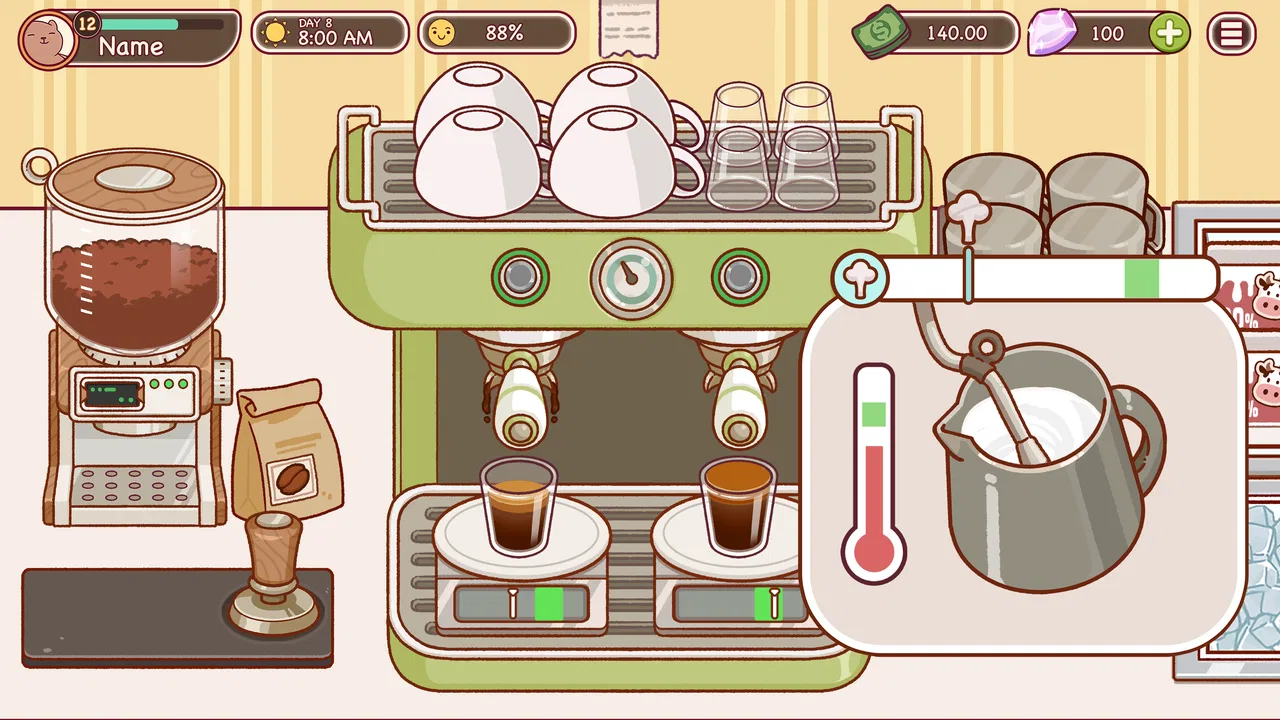
The central appeal is immediate: a customer arrives, I read what they want, and I prepare the coffee as accurately as I can. There is no complicated business terminology to learn before getting started. The game communicates through the order and the preparation process, so I can understand the basic rhythm quickly even if I have not played a café simulation before.
You May Also Like

 Blood Strike: 2.5 Anniversary
Blood Strike’s Loadouts Turn Every Drop Into a Tactical Gamble
A close look at Blood Strike’s custom loadouts: how fast access to signature weapons reshapes its battle royale rhythm, rewards preparation, and narrows the gap between fights.

 Pandora - Music & Podcasts
Pandora’s Music Is Easy to Start, but Harder to Recover
Pandora’s strength is its low-effort path from a seed to a station. Its weak spot is how much confidence it asks you to place in connection, setup, and quiet recovery.

 8 Ball Pool
 Is Built on Rivalries, Rematches, and Routine
A close look at the rivalries, rematches, shared routines, and unanswered safety questions that turn a quick pool match into a persistent mobile community.

 Samsung Music
’s Quiet Strength Is Playing What You Already Own
Its reach comes less from spectacle than from dependable access to a personal library. That simplicity is both the app’s strongest retention engine and its ceiling.

 AccuWeather: Weather Radar
AccuWeather Review: A Quick, Clear Forecast for Everyday Decisions
For everyday plans, the best forecast is the one you can understand quickly. AccuWeather makes rain timing, radar, and local conditions easy to act on, with a few trade-offs.

 Hill Climb Racing
Why Hill Climb Racing Still Turns Crashes Into One More Run
A tiny car, a bumpy hill and one more upgrade: Hill Climb Racing keeps resurfacing because its simple chaos makes every near-miss feel personal.
More From Our News Desk



That simplicity is useful on a busy day. I can imagine playing it while waiting for a train, taking a short break, or winding down before bed. It does not demand the same attention as a strategy game with a large map or a long chain of objectives. A few orders can feel like a complete session, which is one of its strongest qualities on a phone.
At the same time, the relaxed presentation should not be mistaken for a completely passive experience. I still need to pay attention to what each customer asks for and avoid rushing through the preparation. The satisfaction comes from turning a short request into the right drink, not from watching numbers rise automatically. When I make a mistake, the result is more noticeable because the task itself is so focused.
My most useful habit was to slow down before starting an order. I read the request once, identify the important parts, and only then begin preparing it. That small pause is more effective than trying to move quickly from the start. It also makes the game feel less like tapping randomly and more like following a short service workflow.
Progress that rewards attention rather than speed alone
The progression works best when I treat each order as practice. Instead of concentrating only on finishing a sequence, I pay attention to which part of the preparation caused trouble. If I repeatedly misread a request, the solution is not necessarily faster tapping; it may be taking a moment to separate the drink type from the customer’s other instructions.
This is a useful distinction for new players. The game can look extremely simple from the outside, yet small lapses in attention make the experience less smooth. I found that accuracy creates its own sense of progress. A successful run feels satisfying because I understood the request and carried it out cleanly, not merely because I reached the end of a level.
There is also a natural pressure curve in this sort of café game. At first, the task feels like a calm introduction to the controls. Later, the presence of customers and the need to respond correctly can make the same basic actions feel more urgent. That pressure is welcome in moderation, because it prevents the routine from becoming completely automatic.
However, players who dislike timed or customer-service tension should know what they are signing up for. Even with a cozy presentation, a café simulation is built around responding to requests. If I want a game where I can experiment without consequences or where every action is purely decorative, this may not be the best fit.
A practical way to play without turning it into work
I recommend treating the game as a short-session title instead of forcing a long play period. The format suits small breaks, and stopping after a handful of orders helps preserve the pleasant mood. When I continue for too long, the repeated preparation cycle can feel more routine than rewarding, especially if I am playing only to clear progress rather than because I am enjoying the café atmosphere.
Another useful approach is to separate practice from performance. During a relaxed session, I focus on remembering how the game presents requests and how the preparation responds to my actions. When I return later, I can work more confidently without feeling that every order is a test. This is particularly helpful for younger players, who may enjoy learning the pattern at their own pace.
The game is also a reasonable choice for someone who wants a food-themed simulation without the complexity of a full restaurant-management title. I do not need to plan a large menu, balance staff schedules, or study a long economic system before I can enjoy the core activity. That narrower scope is a strength for casual players, although it naturally limits the depth available to people who want extensive customization and management.
Spending, fairness, and what I would watch before buying
The game is free to download, which makes trying the basic experience straightforward. It includes in-app purchases ranging from $0.99 to $99.99 per item. That is an important part of the decision, particularly for families: the download costs nothing, but optional spending can cover a wide range, so I would use device purchase controls if children will be playing.
I do not view the presence of purchases as an automatic reason to reject the game. Many free mobile simulations use optional purchases to support continued development or to give players shortcuts. The more important issue is whether the game remains enjoyable without paying. From my perspective, the core coffee-making loop is the reason to try it, and I would decide whether to spend only after learning whether the free experience already gives me enough variety and progress.
My advice is simple: do not buy anything during the first session. Play long enough to understand what the ordinary routine feels like, then ask whether a purchase would genuinely improve the way you play or merely remove a little waiting and effort. That distinction matters in a game built around repeating small tasks. If the preparation itself is enjoyable, skipping it may reduce the part that attracted me in the first place.
For parents, the Everyone rating is reassuring from a content perspective, but it does not replace spending safeguards. I would still check the device’s purchase settings and make sure the person playing understands that free installation and optional purchases are separate things. This is practical advice rather than a criticism of the game: a broad age rating makes access easier, so clear household rules become more important.
Does paying create a competitive advantage?
Good Coffee, Great Coffee is not the type of game I approach as a competitive contest against other players. My progress is primarily about serving customers and improving my own handling of the café routine. Because of that, spending feels less like buying a direct advantage over another person and more like a possible shortcut within a personal simulation.
That does not mean purchases are irrelevant to fairness. A player who pays may move through available content or resources differently from someone who never spends. For me, the fairest way to judge the game is to ask whether the unpaid version remains a complete, enjoyable activity rather than whether every player advances at exactly the same pace. If I am playing for relaxation, a slower route can be acceptable as long as it does not make the basic café work feel pointless.
I would not recommend it to someone specifically searching for a skill-based competitive game where money must have no influence at all. That is simply not the role this title fills. Its appeal is personal mastery of orders and preparation, not a tournament ladder or a head-to-head test. Players who want competitive fairness in the strictest sense may be happier with a game designed around fixed rules and no purchase-based progression.
There are also details I would want to observe over a longer period before making a firm judgment about spending pressure. The purchase range is clear, but the way each item affects the play experience is not something I can responsibly summarize without inventing specifics. I prefer to say that plainly: try the free routine first, pay attention to how often the game presents purchase prompts, and make the decision based on your own tolerance for that friction.
What makes it different from other café games
Compared with a traditional time-management restaurant game, this one feels more focused on the drink-making interaction itself. A broader restaurant alternative may give me more staff, tables, upgrades, and business decisions. That can be more satisfying when I want a sense of running an entire operation, but it can also create more pressure and more menus to manage.
Compared with a purely decorative cooking game, Good Coffee, Great Coffee gives my actions a clearer service purpose. I am not just arranging ingredients for visual effect; I am responding to a customer’s request. That makes careful reading more important than simply choosing the most attractive option. The trade-off is that the experience can become repetitive for players who need constant new mechanics.
Its strongest competitive advantage, in my view, is accessibility. I can understand the premise quickly, and the coffee theme is familiar enough to make the requests feel approachable. Its weakness is the same narrow focus: anyone expecting a detailed café tycoon, a large social world, or a serious multiplayer contest should look elsewhere. This is a small, direct simulation rather than an all-in-one restaurant game.
Questions I would answer before installing
If you are wondering whether it is suitable for a child, the Everyone rating makes it a reasonable candidate from a content standpoint. I would still supervise purchases, especially because optional items can cost as much as $99.99. The game’s simple café premise is easy to understand, but the right household settings matter whenever a free game includes paid items.
If you are asking whether it works offline, I would not make a promise without checking the exact behavior on your device and current release. The safer expectation is to install and test the situations that matter to you before relying on it during travel. That is particularly important if you want a game for a commute or a place with unreliable service.
If you are concerned about storage or device compatibility, the listed minimum operating-system requirement is Android 7.1. That makes it accessible to many older Android devices, although the smoothness of any game can still vary by hardware. I would keep the current version installed, since the available release is 1.17.5 and updates can affect stability or the way the game feels.
If you are deciding whether it is worth spending money, my answer is to wait. The free download gives you a chance to discover whether the coffee routine itself holds your attention. Only consider an optional item after you know what problem it solves for your play style. A purchase that removes an annoyance may be useful for one person and unnecessary for another.
Finally, if you want a game to play for hours every day, I would be cautious. Its short, repeatable café interactions are ideal for brief sessions, but they may not provide enough variety for someone who needs a constantly expanding challenge. I would choose a deeper management simulation instead if planning, optimization, and long-term business decisions are the main reasons I play.
My trust verdict after spending time with the café
I come away from Good Coffee, Great Coffee with a positive but measured opinion. It understands the value of a clear loop: read the request, make the drink, and try to serve it properly. That is enough to create a pleasant mobile break, especially when I want something more interactive than a passive puzzle but less demanding than a full strategy game.
The game earns my recommendation for casual players, coffee fans, families looking for an Everyone-rated simulation, and anyone who enjoys improving through careful repetition. I particularly like the way a small pause before each order can make the experience more accurate and less stressful. That is not an obvious feature advertised by the premise; it is a practical play habit that turns the routine into a modest skill exercise.
My reservations are equally clear. The focused structure may feel repetitive, the customer-service pressure will not suit every player, and the broad in-app purchase range means I would approach spending carefully. The game is free to try, but free does not mean every player will find the same value in the optional items. I would judge those purchases by whether they support enjoyment rather than by assuming they are necessary.
My final recommendation is to try it as a cozy short-session simulation, not as a deep café-management game. If the pleasure of getting individual orders right is enough for you, the game has a welcoming rhythm and a low barrier to entry. If you need extensive strategy, guaranteed purchase-free progression, or serious competition, another category of game will serve you better. For my own phone, I would keep it as a relaxed café stop between more demanding games, returning when I want a simple task that rewards attention without asking for a major time commitment.
In that role, Good Coffee, Great Coffee is easy to understand, pleasant to revisit, and honest enough to recommend with sensible spending boundaries. TapBlaze has built a simulation around a familiar activity rather than burying it under complicated systems. That restraint is exactly why it works for me—and also why I would tell a dedicated management-simulation fan to check the free experience first before expecting something much larger.
FAQs for Good Coffee, Great Coffee
01What features does Good Coffee, Great Coffee offer?
Good Coffee, Great Coffee provides a range of features designed to enhance your coffee experience. It includes a comprehensive coffee recipe guide, a brewing timer, and personalized recommendations based on your taste preferences. The app also offers a community forum where users can share tips and experiences, making it a versatile tool for coffee enthusiasts.
02Is Good Coffee, Great Coffee free to use?
The app offers a free version with basic features, which is great for casual users. However, for those looking to unlock advanced features such as exclusive recipes, ad-free browsing, and detailed brewing analytics, a premium subscription is available. This ensures that both beginners and coffee aficionados find value in the app.
03Can I use Good Coffee, Great Coffee offline?
Yes, Good Coffee, Great Coffee offers offline capabilities for many of its features. You can access saved recipes and utilize the brewing timer without an internet connection. However, features that require community interaction or real-time updates may need online access to function properly.
04How user-friendly is the Good Coffee, Great Coffee app?
The app is designed with user-friendliness in mind, featuring an intuitive interface that is easy to navigate. New users will find straightforward tutorials and a well-organized menu system, ensuring that even those new to coffee brewing can quickly get started. The app’s design is aesthetically pleasing, adding to the overall user experience.
05Does Good Coffee, Great Coffee offer customer support?
Absolutely, Good Coffee, Great Coffee provides robust customer support. Users can access a help section within the app, which includes FAQs, a troubleshooting guide, and a contact form for direct assistance. The support team is responsive and aims to resolve issues promptly, ensuring a smooth user experience.
Pros
- Simple and intuitive user interface.
- Wide variety of coffee recipes available.
- Regular updates with new content.
- Offline mode for easy access anywhere.
- Customizable settings for preferences.
Cons
- Limited integration with smart devices.
- No social sharing features available.
- Requires in-app purchases for some content.
- Ads can be a bit intrusive at times.
- No option for user-submitted recipes.

Good Coffee, Great Coffee
Gallery